
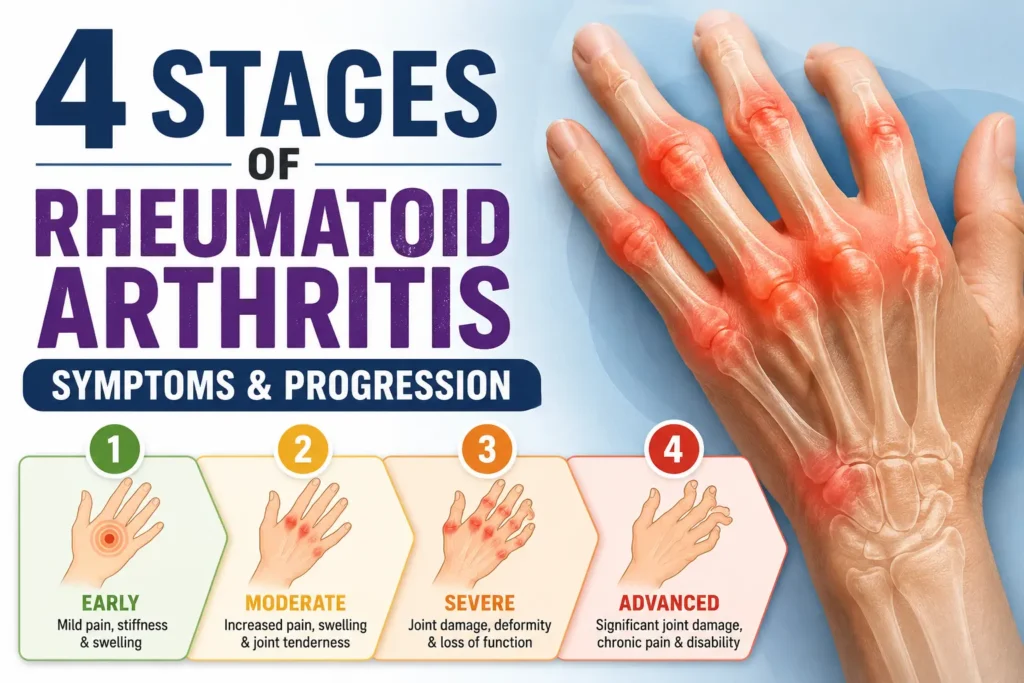
RA, or rheumatoid arthritis, is more than a joint condition. It is basically an autoimmune condition in which healthy tissues, synovium, a healthy lining around the knees, are mistakenly damaged by the immune system. This causes the body to have a continuous inflammatory response, which leads to discomfort, stiffness, and long-term damage to the joints.
It can impact daily movement over time and drastically reduce quality of life. So basically having knowledge of the stages can help you understand it properly and reduce the risk of progression.
What Is Rheumatoid Arthritis?
Rheumatoid arthritis (RA) is an autoimmune disorder caused by the immune system attacking healthy joint tissue, particularly the synovium, after mistakenly identifying it as a threat. This results in inflammation in the body, causing pain, swelling, and stiffness. Over time, repeated inflammation can damage the cartilage and bone.
RA affects the same joints on both sides of the body. It normally starts from smaller joints like in the fingers, toes, and wrists and later spreads to larger joints such as knees, shoulders, and elbows. If it is not treated, then it also starts affecting the other parts in the body, including eyes, lungs, heart, and skin.
What Are the Four Stages of Rheumatoid Arthritis?
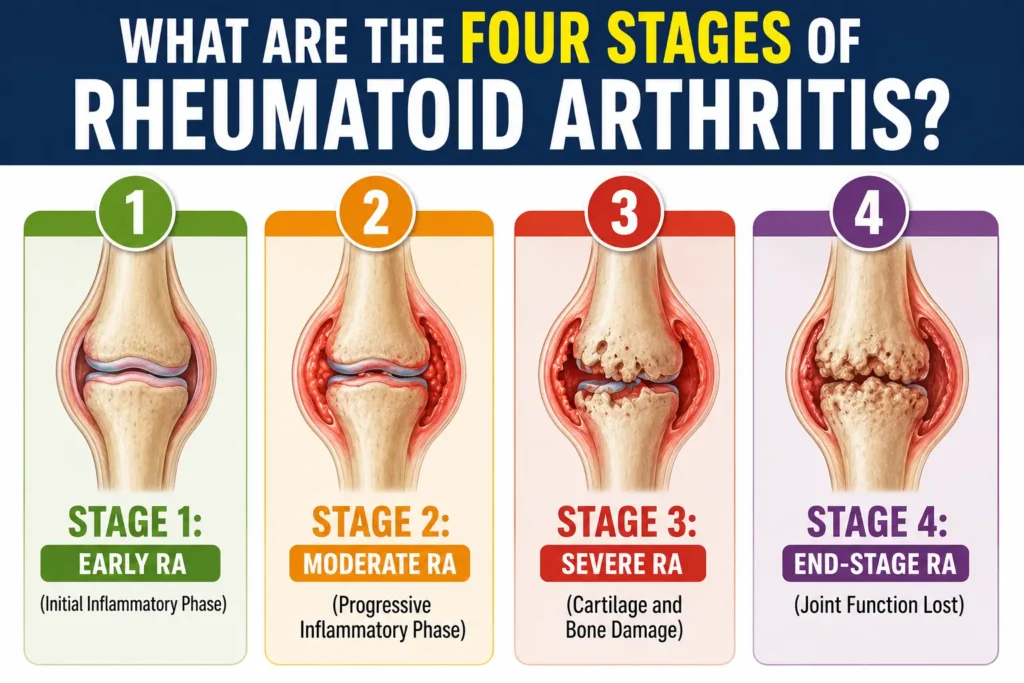
Image Reference: AI or Chatgpt
Stage 1: Early RA (Initial Inflammatory Phase)
It occurs when your immune system begins to target the synovium, which triggers inflammation along the lining of the joints. At this stage, there is usually no permanent damage to the cartilage or bones, even though inflammation has already started.
What you might feel:
- Morning stiffness lasting 30 minutes to an hour or more
- Mild joint pain or tenderness
- Light swelling in one or two joints, often fingers, wrists, or toes
- Warmth around the affected joint
- Unexplained fatigue
- Symptoms that come and go rather than staying constant
What tests might show: X-rays usually look completely normal here, so don’t be surprised if a scan comes back “clean” even though something feels off. Blood tests might show slightly elevated inflammation markers like CRP or ESR, but not always. This is exactly why stage 1 is frequently missed, as the early symptoms are often mistaken for overuse, a minor injury, or normal age-related aches and pains
Stage 2: Moderate RA (Progressive Inflammatory Phase)
Inflammation has been sticking around long enough that it’s started reaching the cartilage that cushions your joints. The joint lining itself may thicken too, which is part of why movement starts feeling harder.
What you might feel:
- More consistent joint pain, not just occasional twinges
- Swelling and some redness around joints
- Morning stiffness that now lasts over an hour
- A noticeable dip in how far you can move the joint
- Trouble gripping, lifting, or holding things (jars, mugs, grocery bags)
- More frequent flare-ups and higher fatigue overall
What tests might show: X-rays can start picking up early changes now, narrowing of the joint space from cartilage thinning, and some bone loss right at the joint edges. This shift usually happens within the first 6 to 24 months after symptoms begin, which makes it a key window. Starting DMARDs or biologics around now can genuinely slow or stop further damage.
Stage 3: Severe RA (Cartilage and Bone Damage)
Inflammation has worn down cartilage enough to start damaging the bone underneath. The joint becomes less stable, and physical changes start showing.
What you might feel:
- Strong, persistent pain that doesn’t fully ease up
- Swelling and stiffness that stick around
- Visible changes, twisted fingers, thickened knuckles
- Joints that feel loose or unstable
- A real loss of range of motion
- Pain just from doing normal daily tasks
What tests might show: X-rays at this stage are pretty unmistakable, cartilage destruction, bone erosions (small pits or holes), and sometimes subluxation, where a joint partially shifts out of place. Symptoms are usually obvious enough that doctors don’t need much extra testing to confirm what’s going on.
Stage 4: End-Stage RA (Joint Function Lost)
Inflammation itself may actually settle down here, but the damage already done doesn’t reverse. Bones can fuse together (a process called ankylosis), and the joint essentially stops doing its job.
What you might feel:
- There can be chronic, severe pain in your joints
- Minimal to almost no movement in the affected joints
- Performing everyday task seems to be impossible due to pain
- There can be muscle weakness around the affected joint
- You can feel complication related to heart, lungs, or bones
What tests might show: X-rays show fibrous or bony fusion, collapse of the joint structure, and a near-complete loss of function in severe cases. Joint replacement surgery is often the path forward here to restore movement and ease pain.
Rheumatoid Arthritis Symptoms by Stage
| Stages | Inside the joint | What you may feel |
| Stage 1 | The immune system begins attacking the synovium (joint line), resulting in inflammation but no obvious bone or cartilage damage | Morning stiffness that lasts for 30 to 60 minutes, mild joint pain or tenderness, and intermittent symptoms of slight swelling |
| Stage 2 | The cartilage begins to deteriorate due to persistent inflammation, and the joints’ internal space begins to constrict. | Consistent pain, noticeable swelling, reduced flexibility, fatigue and difficulty with everyday tasks like gripping or lifting |
| Stage 3 | Cartilage is significantly damaged or lost, and bones may start to rub each other, leading to erosion | Muscle weakness, noticeable joint abnormalities or alterations, persistent pain, and significant difficulties carrying out daily tasks |
| Stage 4 | Active inflammation may reduce, but the joint is severely damaged and may become fused (ankylosis) | Significant loss of function in the afflicted joint, persistent stiffness or pain, and extremely little or no joint movement |
How Fast Does Rheumatoid Arthritis Progress?
About the progression of RA, there is no single timeline, as it can vary from person to person depending on factors such as age and genetics. There are cases in which people with RA have lived for decades without moving past stage 1 or 2, while following a proper treatment. Others, particularly with a more aggressive form of the disease, can jump from stage 1 to stage 3 in just a few years if untreated.
People who test positive for anti-CCP or rheumatoid factor, smoke, or develop symptoms early often experience faster disease progression. That’s why doctors stress early diagnosis-the first one to two years are often the most important for slowing down joint damage with treatment.
How Rheumatoid Arthritis Is Diagnosed
To diagnose RA, doctors will look at several factors, like your symptoms, and will do some physical examination of your joints, blood tests, and, in some cases that seem serious, imaging tests may also be done.
Because RA symptoms can look similar to those of other conditions, confirming the diagnosis may take time.
1. What Your Doctor Will Ask
RA symptoms are similar to other diseases also, so to determine the underlying causes, your healthcare professional will ask some questions, like:
- When did your joint pain or swelling start?
- Which joints tend to be the most painful, swollen, or stiff?
- Does your morning stiffness last longer than 30 minutes?
- Do you have fatigue, a fever, or difficulty moving your joints?
- Does anyone in your family have rheumatoid arthritis or any autoimmune diseases?
RA symptoms often remain for a minimum of 6 weeks and appear on both sides of your body (for example, both hands or both feet).
2. The Physical Exam
A rheumatologist (an expert in treating disorders involving joints and the body’s immune system) will:
- Lightly touch your joints to find out if any of them have swelling, warmth or tenderness
- Assess how well you can move each of your joints
- Determine how many of your joints have been affected
- Look for swelling that is present on both sides
- Look for hard lumps under the skin (Rheumatoid Nodules)
This will allow you to see the patterns of your symptoms and identify their cause.
3. Blood Tests
Blood tests are performed to aid in the diagnosis of RA but cannot alone confirm a diagnosis of RA. Common blood tests performed include:
- Rheumatoid Factor (RF): Elevated in many patients with RA, but may be present in some persons without RA.
- Anti-CCP Antibodies: More specific for RA, a positive test strongly indicates the presence of RA and is often found early in the course of disease.
- Inflammatory Markers (ESR, CRP): Indicate the level of inflammation present in the body but will not indicate what type of inflammatory condition is causing the inflammation.
- Other Tests: A physician may assess for the presence of additional antinuclear antibodies (ANA) or other antibodies to rule out other connective tissue disorders (lupus).
Therefore, some patients with RA may have normal laboratory tests, so laboratory test results alone cannot be used to determine if a patient has RA.
4. Imaging Tests
Visual imaging looks at what is inside your joints.
- X-ray – Provides evidence of bone damage, narrowing of joint space, and erosions (bone damage may be minimal with early RA).
- Ultrasound – Can detect the inflammatory process before X-ray imaging.
- MRI – Produces detailed images of the joints and enables the diagnosis of RA at its earliest stage.
Imaging is beneficial to measure the progression of the disease and to determine the best treatment approach.
How Rheumatoid Arthritis Is Treated at Different Stages
RA does not have any permanent cure, so the treatment is done to control the symptoms, like reducing the inflammation, pain, and swelling that helps in protecting the joint from long-term damage.
1. Medications
Medications are usually the main part of RA treatment. Doctors often use disease-modifying antirheumatic drugs (DMARDs) to slow down joint damage and control inflammation. For more severe cases, biologic medications may be utilized to target the part of the immune system that is triggering the disease.
2. Physical and Occupational Therapy
The main objective of occupational therapy is to make everyday activities easier by teaching the RA patient some joint-protection techniques. This will help in enhancing joints’ flexibility, mobility, and muscle strength.
3. Lifestyle Changes
In order to effectively manage rheumatoid arthritis (RA), lifestyle modifications are crucial. It can help support the care provided by your physician. When living with RA, one should do the following:
- Can perform regular, low-impact exercise routine
- Keeping healthy body weight
- Having more anti-inflammatory diet, including foods high in omega-3 fatty acids.
- Have proper rest and sleep
- Managing stress
- Avoiding tobacco products
- Maintain consistently healthy daily habits.
4. Surgery
Surgery is suggested by the physician as the last option for RA when the joints are badly damaged or not able to function properly (stage 3 or 4). In this method, surgeons remove the inflammatory lining of the joint, which helps heal torn tendons. In some rare cases if there is a need, then joint replacement is performed (knee or hip replacement) to improve the joint mobility and reduce the pain.
Can Rheumatoid Arthritis Progression Be Slowed?
Yes, you slow down the progression of rheumatoid arthritis by having an early diagnosis and treatment. However, RA has no permanent cure, but having early treatment can help in reducing the inflammation and prevent joints from permanent damage.
Medications like DMARDs and biologics, along with healthy lifestyle changes and regular medical care, slow down the progression of the disease, reduce flare-ups, and protect joint function.
Complications of Rheumatoid Arthritis
Rheumatoid arthritis can affect more than joints; it can even result in complications in other parts of the body, like:
- Rheumatoid Nodules: Firm lumps can develop under the skin due to RA, especially in those areas where pressure is applied (e.g., near the elbow or fingertips).
- Eye Problems: RA can produce redness, irritation, and dryness in the eyes. It has also been known to cause visual problems.
- Lung Disease: RA-related inflammation can damage lung tissues, resulting in difficulty breathing.
- Heart Disease: Chronic inflammatory disease puts an individual at increased risk for developing problems with their cardiovascular system.
- Osteoporosis: RA patients are also at an increased risk of developing osteoporosis, which decreases the strength of bones, leading to an increased risk of injury from fracture-related incidents.
Warning Signs Your RA Is Getting Worse
Watch for these signs:
- More pain and stiffness
- Swelling that doesn’t improve
- Fatigue that won’t go away
- Less movement in joints
- More frequent flare-ups
- Trouble with daily activities (typing, walking, gripping)
- Hard bumps under the skin (rheumatoid nodules)
- Numbness or tingling in fingers
Key Takeaways
- RA moves through four stages, starting with early, invisible inflammation and leading to severe joint damage if ignored.
- Warning signs that your condition is progressing include more frequent flare-ups, swelling that won’t go down, and persistent, heavy fatigue.
- Treatment is highly personal. What works for one person might not work for another, and adjusting your goals with your doctor is a normal part of the process.
Faqs
1. What is the first sign of RA?
Morning joint stiffness, especially in the hands or fingers, that lasts more than 30 minutes with mild swelling or tenderness are some of the signs that show the onset of RA.
2. Can rheumatoid arthritis affect other parts of the body?
Yes, RA can affect other parts of the body too, it is an autoimmune disease. It can possibly affect eyes, lungs, heart, skin, and blood vessels. Extra-articular problems are observed in approximately 40% of patients with RA, according to studies.
3. Is there any cure to RA?
Currently there is no permanent cure for the RA. However, with early treatment and the right medication, you can control RA symptoms and reduce the joint damage.
4. Is RA an autoimmune disease?
Yes, rheumatoid arthritis is an autoimmune disease.
5. Can rheumatoid arthritis be prevented?
RA cannot be completely prevented because genetics and advancing age increase the risk. However, you can reduce the disease’s course by maintaining a healthy weight, staying active, avoiding tobacco products, and getting medical attention early.