

That dull, throbbing ache tucked behind your right eye can be more than annoying — it can throw off your whole day. Whether it feels like pressure building up or a sharp stab that comes out of nowhere, a headache behind the right eye almost always has an identifiable cause, and most of the time, it isn’t serious.
Still, the location of head pain tells a story. Pain concentrated behind one eye points doctors toward a shorter list of culprits than a headache that spreads across your whole skull. In this guide, we’ll walk through what’s likely going on, how to tell one type of headache from another, what actually helps, and the specific warning signs that mean it’s time to call a doctor.
Quick Answer
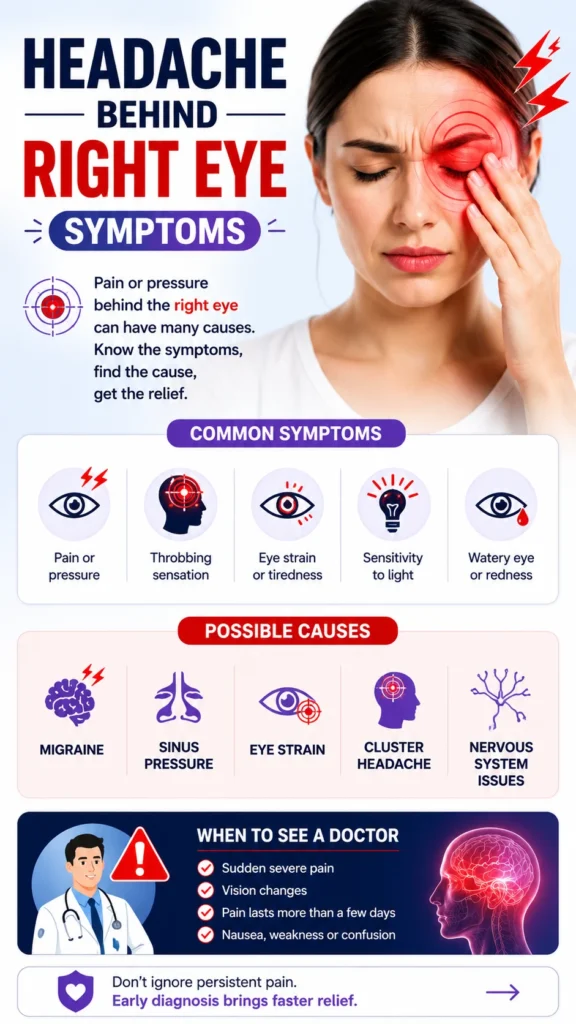
A headache behind the right eye is usually caused by migraine, a cluster headache, sinus congestion, tension headache, or eye strain from screen use. Pain that’s severe, sudden, or paired with vision changes, fever, or confusion needs prompt medical attention, since it could point to something more serious.
Why You’re Getting a Headache Behind Your Right Eye {#why}
The area behind and around your eyes is packed with nerves, sinus cavities, and blood vessels, all sitting close together. When any of them get irritated — whether from inflammation, muscle tension, or changes in blood flow — the pain often gets referred straight to the eye socket. That’s why a headache behind your right eye can stem from something happening in your sinuses, your trigeminal nerve, or even your neck muscles, not just the eye itself.
The right-side location matters too. Migraines and cluster headaches are notorious for sticking to one side of the head, so if your pain has shown up behind your right eye more than once, that pattern is a useful clue for figuring out what type of headache you’re dealing with.
Common Causes, Compared
| Cause | Typical Pain Pattern | Duration | One-Sided? |
|---|---|---|---|
| Migraine | Throbbing, worsens with movement/light | 4–72 hours | Often, but not always |
| Cluster headache | Sharp, burning, drilling pain | 15 minutes–3 hours | Almost always |
| Sinus headache | Dull pressure, worse when bending forward | Days (tied to infection) | Can be one-sided |
| Tension headache | Tight, band-like ache | 30 minutes–several hours | Usually both sides |
| Eye strain | Mild ache, tired eyes | Hours, resolves with rest | Usually both eyes |
Migraine Behind the Right Eye
Migraine is one of the most common reasons people end up with pain behind one eye, and it’s frequently mistaken for something else. <cite index=”6-1″>Research has found that nearly nine out of ten patients who believed they had sinus headaches were actually experiencing migraines.</cite> That’s a significant mix-up, since the treatment for each is completely different.
According to Mayo Clinic, <cite index=”7-1″>migraine pain can show up in different spots — sometimes on one side of the head, sometimes behind the eye, and sometimes across the whole head.</cite> A migraine typically builds gradually rather than hitting all at once, and it tends to come with a cluster of other symptoms:
- Sensitivity to light and sound
- Nausea or vomiting
- Visual disturbances, like flashing lights or blind spots (aura)
- Throbbing pain that worsens with physical activity
Expert insight: Migraine specialists often point to a simple test patients can do at home: if lying down in a dark, quiet room brings noticeable relief, migraine becomes far more likely than a cluster headache, since <cite index=”7-1″>people with cluster headaches tend to feel agitated and want to move around rather than rest.</cite>
Cluster Headache: The Most Intense Culprit
If the pain behind your right eye feels unbearable — like a hot poker or a drill — a cluster headache could be to blame. Cleveland Clinic describes cluster headache as rare, <cite index=”3-1″>affecting an estimated 0.1% of people worldwide, or about 1 in every 1,000 people.</cite>
Mayo Clinic notes that cluster headache is <cite index=”4-1″>a rare, severe headache that causes intense pain in or around the eye on one side of the head, and is typically considered the most painful type of headache people experience.</cite> Attacks tend to arrive in “clusters” — several short, brutal headaches over a period of weeks, followed by long stretches with none at all.
Distinguishing features include:
- Pain that starts suddenly, often at night
- Restlessness — pacing instead of lying still
- Redness, tearing, or swelling around the right eye
- Nasal congestion on the same side as the pain
Per Mayo Clinic’s comparison of the two conditions, <cite index=”7-1″>a cluster headache typically lasts about 30 to 90 minutes, while a migraine tends to last much longer — often an entire day or more if it goes untreated.</cite> It’s also possible to have several cluster headache attacks in a single day, which is unusual for migraine.
Certain factors raise the odds of developing cluster headaches. Mayo Clinic identifies <cite index=”4-1″>being male, being between 20 and 50 years old, smoking, drinking alcohol during a cluster period, and having a close family member with the condition as factors linked to higher risk.</cite>
Sinus Pressure and Headache
Your sinuses sit directly behind your forehead, cheekbones, and eyes, so when they’re inflamed or congested, that pressure often radiates straight into the eye socket. Cleveland Clinic describes this as <cite index=”3-1″>a dull pain behind the eyes, cheekbones, forehead, or nose that shows up as a symptom of a sinus infection.</cite>
The catch is that true sinus headaches are rarer than most people assume — a lot of what feels like sinus pressure is actually migraine, as mentioned above. A genuine sinus headache usually comes bundled with other signs of infection:
- Thick nasal discharge
- Fever or facial tenderness
- Pain that worsens when you bend forward
- Congestion that doesn’t clear up after a week or two
Read more health topic on usa generam health
Tension Headache and Eye Strain
Tension headaches are the most common headache type overall, and while they usually wrap around the whole head like a tight band, the pressure can concentrate behind the eyes, especially after a stressful day or hours spent hunched over a desk.
Eye strain is a separate but closely related cause. Long stretches of screen time, reading in poor lighting, or uncorrected vision problems force your eye muscles to overwork, which can trigger an ache that settles right behind the eye. Reduced blinking, small text, and sitting too close to a screen are all common contributors.
Pros and cons of common relief approaches:
- Rest and screen breaks — Pro: free, no side effects. Con: slow to work if strain has built up over days.
- Over-the-counter pain relievers — Pro: fast-acting. Con: overuse can lead to rebound headaches.
- Vision correction (glasses/contacts) — Pro: addresses the root cause. Con: requires an eye exam and adjustment period.
Less Common Causes Worth Knowing
A few less frequent conditions can also cause pain behind the right eye specifically:
- Thyroid eye disease, linked to Graves’ disease, can cause swelling behind the eyes that leads to headache-like pain, particularly when moving the eyes.
- Hemicrania continua, a rare, persistent one-sided headache disorder.
- Optic neuritis, inflammation of the optic nerve, which usually comes with vision changes and pain during eye movement.
- Increased eye pressure, as seen in some forms of glaucoma, which can cause aching behind the eye along with blurred vision.
These are far less common than migraine, tension headache, or cluster headache, but they’re worth mentioning to a doctor if your symptoms don’t fit the usual patterns.
Symptom and Treatment Table
| Condition | Key Symptoms | First-Line Treatment |
|---|---|---|
| Migraine | Throbbing pain, light/sound sensitivity, nausea, aura | Rest in a dark room, OTC or prescription migraine medication |
| Cluster headache | Severe one-sided pain, tearing, restlessness | High-flow oxygen, prescription injections or nasal sprays |
| Sinus headache | Facial pressure, congestion, worse leaning forward | Decongestants, saline rinses, treating the underlying infection |
| Tension headache | Band-like tightness, mild-to-moderate pain | OTC pain relievers, stress management, stretching |
| Eye strain | Tired eyes, mild ache, blurry vision | Screen breaks, the 20-20-20 rule, corrective lenses |
How to Get Relief at Home
For mild, occasional headaches behind the right eye, a few simple steps often help:
- Step away from screens every 20 minutes and focus on something 20 feet away for 20 seconds.
- Stay hydrated — dehydration is an underrated headache trigger.
- Apply a cool compress over the eye for migraine-type pain, or a warm compress for sinus pressure.
- Keep a headache log noting time of day, food, sleep, and stress levels to spot your personal triggers.
- Practice good sleep hygiene, since irregular sleep is a known migraine and cluster headache trigger.
None of these replace a proper diagnosis if the pain is frequent, severe, or unusual for you.
When to See a Doctor
Most headaches behind the eye are manageable, but certain symptoms deserve immediate medical attention:
- The worst headache of your life, especially if it starts suddenly
- Headache with fever, stiff neck, or confusion
- New vision changes, double vision, or vision loss
- Weakness, numbness, or trouble speaking
- Headaches that wake you from sleep repeatedly or follow a clear daily pattern
- Pain following a head injury
If your headaches are becoming more frequent, more severe, or are starting to interfere with work and daily life, it’s worth scheduling an appointment even without red-flag symptoms. A doctor can rule out underlying causes and point you toward treatment that actually targets what’s going on, rather than just masking the pain.
Key Takeaways
- A headache behind the right eye is most often caused by migraine, cluster headache, sinus pressure, tension headache, or eye strain.
- Migraine is frequently mistaken for sinus headache — the two are treated very differently.
- Cluster headaches are rare but extremely intense, often described as among the most painful headache types.
- Restlessness during an attack points toward cluster headache; wanting to lie still in the dark points toward migraine.
- Sinus headaches usually come with other infection symptoms like congestion or facial tenderness.
- Screen-related eye strain is a common, often overlooked cause of one-sided head pain.
- Sudden, severe pain or pain with vision changes, fever, or confusion needs urgent medical care.
- Keeping a headache log helps identify personal triggers and speeds up diagnosis.
FAQs
Why do I have a headache behind my right eye?
The most common reasons are migraine, cluster headache, sinus congestion, tension headache, or eye strain from extended screen use. The exact cause usually depends on how the pain feels, how long it lasts, and whether other symptoms like nausea, tearing, or congestion come with it.
Is pain behind the right eye always a migraine?
No. While migraine is a frequent cause, cluster headaches, sinus pressure, and tension headaches can all produce pain in the same spot. Migraine is more likely if the pain throbs, worsens with activity, and comes with light sensitivity or nausea.
What does pressure behind the right eye headache usually mean?
Pressure, as opposed to sharp pain, often points to sinus congestion or tension headache. That said, many people who describe “sinus pressure” are actually experiencing migraine, so it’s worth tracking whether other migraine symptoms are present.
Can eye strain cause a headache behind the eye?
Yes, since the sinuses sit close to the eyes, an infection can cause pressure that radiates behind them. This is usually accompanied by nasal congestion, facial tenderness, and pain that worsens when bending forward.
Is a headache behind one eye a sign of something serious?
Usually not — most cases trace back to migraine, tension headache, or sinus pressure. However, persistent one-sided pain, especially with vision changes, should be evaluated by a doctor to rule out less common causes.
What’s the difference between a migraine and a cluster headache behind the eye?
Migraines build gradually, often last a full day or longer, and typically come with nausea and light sensitivity. Cluster headaches strike suddenly, are shorter but far more intense, and often cause restlessness, tearing, and redness on the same side as the pain.
Can stress cause a headache behind the right eye?
Yes, stress is a well-known trigger for both tension headaches and migraines, and it can concentrate pain behind the eyes. Managing stress through regular sleep, exercise, and relaxation techniques can reduce how often these headaches occur
References
- Mayo Clinic — Cluster Headache: Symptoms and Causes
- Cleveland Clinic — Cluster Headaches
- Mayo Clinic News Network — What’s the Difference Between Cluster and Migraine Headaches?
- Healthline (medically reviewed) — Headache Behind Eye
- All About Vision — Headache Location Meaning: Behind the Eyes, Side of Head & More