

Growing up with Ehlers-Danlos Syndrome often means living with symptoms that people around you may not fully understand. Many children and teenagers are called “clumsy,” “too flexible,” or “overdramatic” long before they ever receive a diagnosis. For some, it can take years to realize that the everyday struggles they experienced were actually connected to a genetic connective tissue disorder.
Because Ehlers-Danlos Syndrome (EDS) affects collagen in the body, it can impact joints, skin, muscles, digestion, energy levels, and even the cardiovascular system. The signs can appear differently in every person, which is one reason diagnosis is often delayed. Looking back, many adults with EDS begin connecting childhood experiences that once seemed random or unrelated.
What Exactly Is EDS?
Ehlers-Danlos syndrome is a group of inherited disorders that affects the body’s connective tissues, which are responsible for supporting joints, skin, muscles, blood vessels, and the organs.
Connective tissues are generally formed from collagen, which acts like the body’s natural support system, or you can even call it “glue.” In people who have EDS, the body produces weak or faulty collagen. As a result, joints become weak and unstable, the skin gets fragile, and different parts of the body may not function as strongly as they should.
There are several types of EDS, but hypermobile EDS is the most common. Symptoms can range from mild flexibility issues to severe complications involving blood vessels and internal organs.
Did You Know?
Ehlers-Danlos syndrome is often called an “invisible illness” because many symptoms cannot be seen from the outside. Someone with EDS may appear completely fine while silently dealing with chronic pain, fatigue, dizziness, digestive issues, and repeated injuries every day.
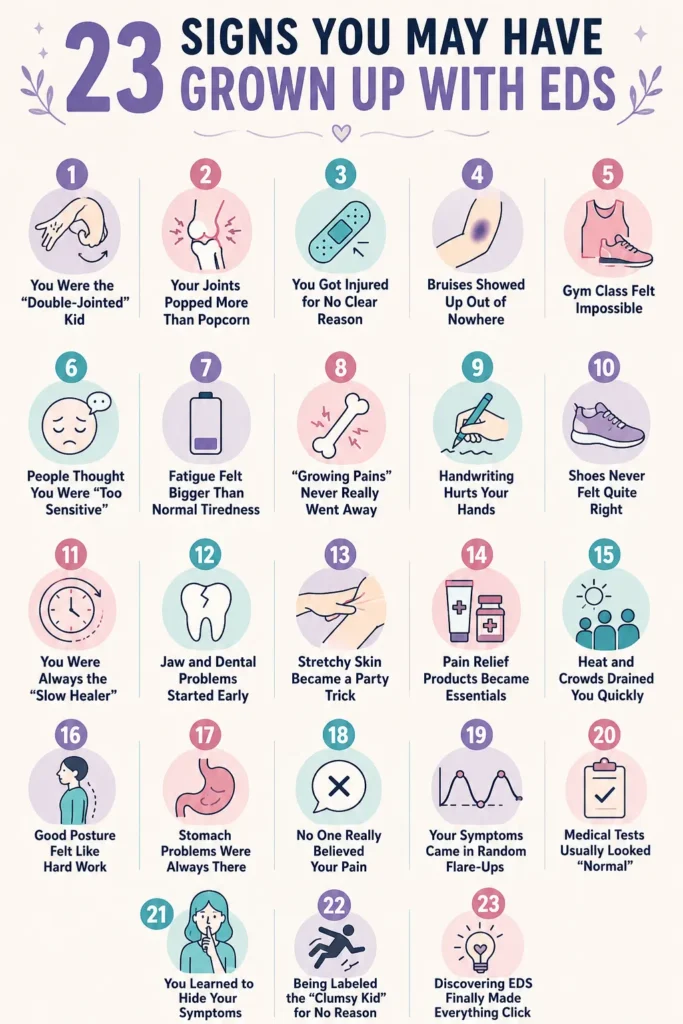
23 Signs You May Have Grown Up With EDS
1. You Were the “Double-Jointed” Kid
You could bend your fingers, elbows, knees, or shoulders in unusual ways that make everyone’s eyes pop out in amazement. Adults thought it was a fun talent, but excessive flexibility is actually one of the most common early signs of EDS.
2. Your Joints Popped More Than Popcorn
While climbing stairs, your knees probably cracked all the time. Reaching for something made your shoulders pop, and even your wrists or neck joined in sometimes. Your everyday movements are becoming more noisy and uncomfortable.
3. You Got Injured for No Clear Reason
Just walking casually, your ankle got sprained, or, simply, your wrist hurt while carrying a schoolbag. While other kids were playing and enjoying sports, you were still dealing with pain from everyday activities.
4. Bruises Showed Up Out of Nowhere
Your legs and arms always seem covered in bruises, yet you are barely bumped into anything. Cuts and marks took longer to heal and stayed longer than usual.
Fact: fragile connective tissue and delicate blood vessels make easy bruising common in many people with EDS.
5. Gym Class Felt Impossible
Going to gym class seems like a nightmare to you. Simple running, jumping, balancing, or playing leaves you exhausted, sore, or at risk of getting injured. And when you look around, everyone else seems completely fine. You are trying your best, yet still struggling to keep up with friends.
6. People Thought You Were “Too Sensitive”
You are having headaches, body pain, or tiredness, but adults rub it off that you are looking for attention or just looking for an excuse or might be exaggerating.
They might be telling you:
- You are too young to be in pain.
- Just do exercise more and be more physically fit.
- Oh, it’s nothing; your tests are just normal.
7. Fatigue Felt Bigger Than Normal Tiredness
You are sleeping more than usual and still feeling drained. School days, shopping trips, or family functions, instead of being enjoyable, are left completely exhausting.
This is not ordinary tiredness; it is something where your body is shutting down faster than everyone else’s.
8. “Growing Pains” Never Really Went Away
“Oh, that constant pain is something you can’t explain to anyone. Leg pain, back pain, aching hips, or sore joints keep following you from childhood to your teenage years. People generally say it is just growing pain, but only you know that it keeps coming back.”
9. Handwriting Hurts Your Hands
When you write, your hands start shouting, “Oh no, not again,” and your fingers start cramping. Pens slip from your hands, and long writing sessions become more painful and mentally as well as physically tiring.
Joint instability in the fingers and wrist does not support hand movement and can make handwriting surprisingly difficult for people with EDS.
10. Shoes Never Felt Quite Right
Not being able to find the right shoe, flat feet, unstable ankles, or foot pain made shoe shopping frustrating. And if somehow you luckily found the right shoe, then it left you with blisters or caused soreness in the foot.”
11. You Were Always the “Slow Healer”
Bruises seemed to stay forever, cuts took longer to heal, and even small injuries left marks behind more easily than you expected. Since collagen plays an important role in skin repair, people with EDS may notice that their skin takes much more time to heal as compared to others.
12. Jaw and Dental Problems Started Early
“Oh, there is that tooth pain, and when you get it checked again, it turns out to be tooth cavities, jaw clicking, gum problems, or TMJ pain that started at a very young age.
In fact, people with EDS may sometimes experience jaw instability or chronic facial pain.”
13. Stretchy Skin Became a Party Trick
You can easily turn your thumb backwards and stretch your body in such a way that people get amazed, calling you a “flexible child.” Everyone in the party is praising you, “Oh my God, what a talent,” without knowing that soft, velvety, or stretchy skin is a common sign of EDS.
14. Pain Relief Products Became Essentials
While your friends are carrying snacks or makeup in their bags, for you it is completely the opposite. You are carrying heating pads, braces, and pain sprays like Moov or Volini for instant pain relief.
For you, pain has become a daily part of your life much earlier than it should.
15. Heat and Crowds Drained You Quickly
Standing in long queues even though it makes you drained or walking through crowded malls, or when summer approaches, you start feeling like this is happening again.
You start feeling sudden pain in joints, dizziness, and daily fatigue that becomes even worse.
16. Good Posture Felt Like Hard Work
Your teacher is asking you to sit straight in the classroom; at home, parents are constantly telling you to sit properly and not to lie down, but only you know that maintaining a proper posture is physically exhausting.
When connective tissues are weak, the muscles have to work much harder just to hold the body up and keep it supported properly.
17. Stomach Problems Were Always There
You are afraid of eating not just outside but even at home also, as it leaves you constipated, making you more nauseous. Regular bloating, acid reflux, or stomach pain is now a daily part of your everyday life.
18. No One Really Believed Your Pain
You are feeling pain in your joints and not feeling like doing anything, but no one believes you because you are not able to explain your pain and your symptoms are invisible.
Your friends or family thought that you were just overreacting, lazy, or just making excuses.
And at last, you don’t even feel like explaining what is happening inside you and stop talking about your pain.
19. Your Symptoms Came in Random Flare-Ups
You are happy and enjoying your day, but suddenly feel that your whole body starts hurting without any reason. Some days are so good, and other days just pain takes over your happiness.
Pain and fatigue are something that comes without any warning, leaving you drained.
20. Medical Tests Usually Looked “Normal”
You finally got your blood tests, X-rays, or scans done, and still you hear from your doctor that everything is fine.
This is very common with EDS because many symptoms don’t appear clearly on routine checkups, too.
21. You Learned to Hide Your Symptoms
You have suffered and felt pain, but nobody understood, so at last you stopped explaining yourself.
And at last you smiled through the pain, started talking quietly about your pain, and tried to push through it alone.
22. Being Labeled the “Clumsy Kid” for No Reason
You often tripped, dropped things, or bumped into objects even when you were extra careful.
You often tripped, dropped things, or bumped into objects even when you were being careful.
For many people with Ehlers-Danlos syndrome, loose joints and reduced stability can make coordination more challenging than it appears.
23. Discovering EDS Finally Made Everything Click
When you hear all these symptoms, you realize that everything is making sense. Years of pain, fatigue, injuries, and unexplained issues suddenly start falling into place.
You realize you weren’t weak or imagining things-you were living with Ehlers-Danlos syndrome all along.
And you stare at a thought, omg, “This sounds like me… Now what?”
If this feels familiar, it may help to speak with a geneticist, a rheumatologist, a physiotherapist familiar with hypermobility, or a support group that understands your experience.
Common Symptoms People With EDS Often Experience
Although symptoms vary depending on the type, some of the most common include:
- Joint hypermobility
- Chronic pain
- Frequent bruising
- Fatigue
- Stretchy or soft skin
- Slow healing
- Digestive issues
- Joint dislocations
- Headaches and dizziness
- Poor balance and coordination
Some rare types, like vascular EDS, can also affect blood vessels and internal organs more seriously.
Why EDS Is Often Missed or Misdiagnosed
Ehlers-Danlos syndrome is frequently misdiagnosed because its symptoms may resemble those associated with many other common illnesses.
As a result, people may initially be told they may suffer from anxiety, fibromyalgia, chronic fatigue syndrome (CFS), growing pains, improper alignment or posture, or even simply being clumsy by nature before the correct diagnosis can be provided to them.
Because everyone with Ehlers-Danlos syndrome presents differently, it can take a long time after presenting full symptoms for a medical professional to realize all the pieces of the puzzle fit together and to be able to diagnose the patient accurately.
Living With EDS
There is currently no cure for Ehlers-Danlos syndrome, but many people successfully manage symptoms through lifestyle adjustments and supportive care.
Treatment often focuses on:
- Physical therapy
- Joint protection
- Pain management
- Better sleep support
- Improving muscle strength
- Managing digestion and circulation
- Avoiding activities that strain unstable joints
Learning how your body works can make everyday life easier and help reduce future injuries.
Final Thoughts
Realizing you may have grown up with Ehlers-Danlos syndrome can feel both emotional and validating. The unexplained pain, continuous fatigue, injuries, and feeling of being misunderstood all flash in front of your eyes.
But finally having answers can also be empowering.
A diagnosis does not change who you are. It simply gives a name to experiences you’ve carried for years – and helps you better understand, protect, and care for your body moving forward.
Frequently Asked Questions about EDS
1. What exactly causes Ehlers-Danlos Syndrome?
Ehlers-Danlos syndrome (EDS) is caused by genetic mutations due to which the body is not able to produce or process collagen. Collagen is a critical structural protein that helps support the skin, joints, blood vessels, and organs while maintaining strength, stability, and flexibility throughout the body.
2. Is Ehlers-Danlos syndrome (EDS) hereditary?
Yes, Ehlers-Danlos syndrome (EDS) is mainly a condition that runs in families. It is generally passed from parents to children, but how it is inherited can be different for everyone depending on the type. In some of the cases, it can also appear due to a new genetic change that wasn’t inherited from either of the parents.
3. Can EDS be cured?
Till now there is no cure present for Ehlers-Danlos syndrome, as it is genetic and affects connective tissues. However, symptoms can be managed with physical therapy, pain relief, and bringing about some changes in regular lifestyle.
4. Does EDS get worse with age?
EDS is not a progressive disease, but symptoms may manifest more as people age due to the continuous amount of stress on their joints and decreased muscle strength, as well as some deterioration in connective tissue over time, resulting in progressively increased pain, greater instability, and an overall feeling that something “isn’t right.”
5. Is it possible for someone with EDS to have a normal life?
Yes, many people with Ehlers-Danlos syndrome (EDS) can still live fulfilling lives, as the symptoms can often be managed with proper care, medical support, and healthy lifestyle adjustments over time.
Reference URL: https://my.clevelandclinic.org/
Get More Article: USA General Health